
Google’s 2026 research on multi-agent AI systems produced an unexpected finding: language models reason more effectively when they interact with other models in simulated debates.
The researchers found that models like DeepSeek-R1 and QwQ-32B improved their performance on complex reasoning tasks through what they described as a “society of thought” approach. Multiple agents would argue different positions, critique each other’s reasoning, and converge on stronger conclusions than any single model could produce alone.
This is a different paradigm from the current approach to AI in software development, where a single model processes a single prompt and returns a single response.
What Multi-Agent Architecture Looks Like in Practice
A multi-agent development system might use one agent to write code, a second to review it for bugs and security vulnerabilities, a third to evaluate architectural decisions, and a fourth to check alignment with project requirements. Each agent specialises in a different concern. Their interactions produce better outputs than a single general-purpose model.
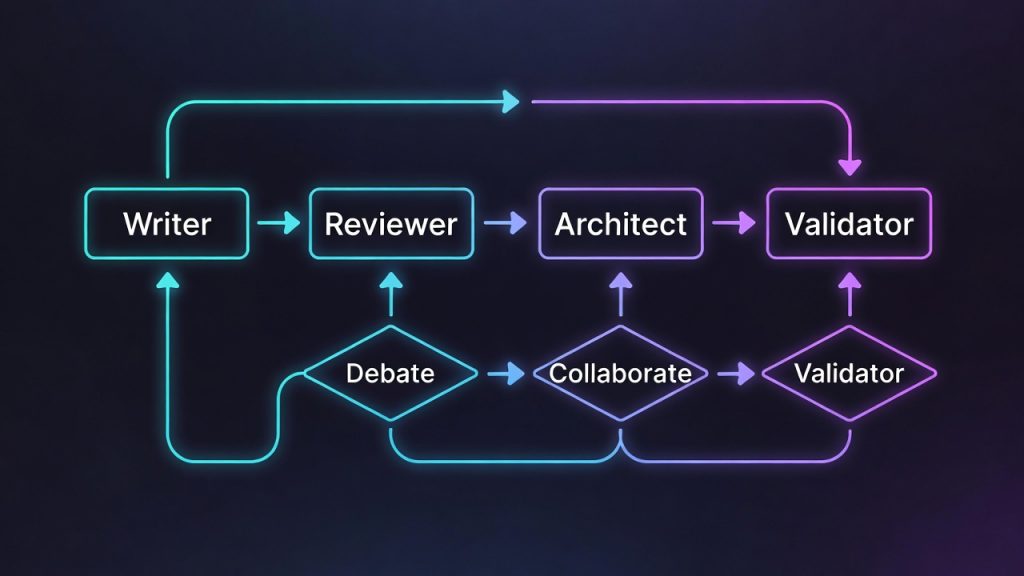
The pattern extends beyond code generation. Planning agents can decompose complex requirements into subtasks. Execution agents can implement each subtask. Validation agents can verify correctness. Coordination agents can manage dependencies and resolve conflicts between competing approaches.
This mirrors how effective human development teams work. No single developer writes, reviews, tests, and architects simultaneously. Specialisation and structured collaboration produce better software than individual heroics.
What This Means for Development Teams
Multi-agent systems do not replace developers. They change the nature of development work. The developer’s role shifts from writing every line of code to orchestrating AI agents, defining quality criteria, and making architectural decisions that agents execute.
The teams that adopt multi-agent AI development will move faster than those that use single-model copilots. The difference is structural. A single copilot augments one developer. A multi-agent system augments the entire development process.
The practical barrier is orchestration. Managing multiple AI agents requires infrastructure for agent communication, task decomposition, conflict resolution, and output assembly. This infrastructure does not exist as a turnkey product today. Building it requires investment in agent frameworks, prompt engineering for specialised roles, and evaluation pipelines that measure multi-agent output quality.
Where This Is Heading
The major platform companies are building toward this future. Google’s Agent tab in AI Studio, Microsoft’s Copilot agent framework, and open-source projects like AutoGen and CrewAI are all implementing multi-agent patterns. Within 12-18 months, multi-agent development tools will be as accessible as single-model copilots are today.
What This Means for Your Business
Multi-agent AI development is moving from research to production tooling. Teams that understand the orchestration patterns now will have a significant advantage when the tooling matures.
FortySeven’s AI Agents and Automation practice helps enterprises design and implement multi-agent architectures for software development. We build the orchestration, evaluation, and integration infrastructure that turns multi-agent AI from a research concept into a production capability.
Contact us at fortyseven47.com/contact-us