
A 2026 survey found that 90% of enterprises run generative AI at scale while 65% of CISOs lack confidence in their data security for AI workloads. Only 20% of AI initiatives meet their defined KPIs.
The common thread across most failed AI projects is data infrastructure. Gartner predicts 60% of AI projects unsupported by AI-ready data will be abandoned through 2026. The model is rarely the bottleneck. The data layer is.
AI-ready data is not the same as data warehouse data. It requires alignment to specific use cases, active governance at the asset level, automated pipelines with quality gates, and continuous quality assurance that updates at the cadence AI development requires.
Most enterprises discover this gap only after selecting a model and starting to build. The result is a cycle of promising demos that collapse when fed real production data.
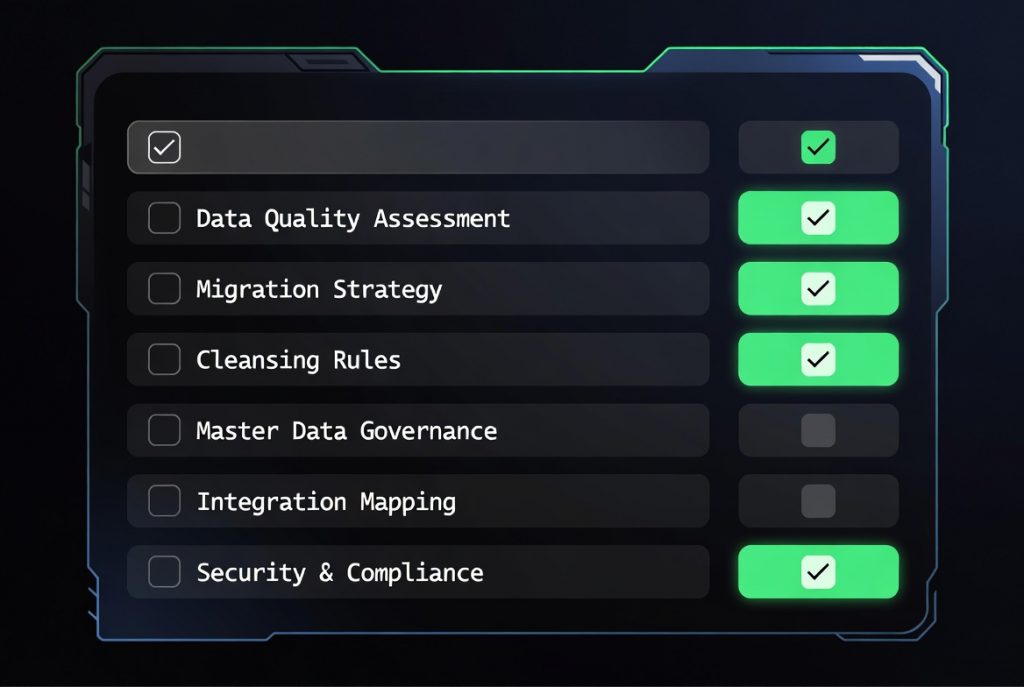
The Checklist
- Data Inventory and Classification: Before any AI project starts, produce a complete inventory of the data assets it will depend on. Classify each asset by sensitivity, quality, freshness, and ownership. Most organisations cannot produce this inventory within a week. That delay is a leading indicator of project failure.
- Data Quality Gates: Build automated checks that validate data before it enters the AI pipeline. Schema validation, null checks, distribution drift detection, and freshness thresholds. These gates catch problems before they corrupt model outputs. Running quality checks manually on a quarterly basis is insufficient for AI workloads that process data continuously.
- Governance at the Asset Level: Assign ownership to individual data assets, not to categories or departments. Each dataset that feeds an AI model needs a named owner who is responsible for its quality, access controls, and compliance status. Department-level governance creates gaps between assets that nobody monitors.
- Access Controls for AI-Specific Patterns: AI workloads access data differently than traditional applications. Training jobs read entire datasets. Inference systems access individual records in real time. Evaluation pipelines compare outputs against labelled test sets. Each pattern requires different access control configurations.
- Metadata Management: AI teams need metadata that describes what data means, where it came from, when it was last updated, and how it relates to other datasets. Without this layer, data scientists spend 60-80% of their time finding, cleaning, and understanding data instead of building models.
- Pipeline Orchestration: Data needs to flow from source systems through transformation, quality checks, and into training or inference environments without manual intervention. A pipeline that requires human steps is a pipeline that will break on weekends and holidays.
- Monitoring and Drift Detection: Data distributions change over time. A model trained on last quarter’s data may produce unreliable results when this quarter’s data shifts. Automated drift detection compares incoming data against training baselines and triggers alerts when distributions diverge beyond acceptable thresholds.
What This Means for Your Business
AI-ready data infrastructure is the prerequisite for every successful AI deployment. Building this infrastructure before selecting a model saves months of rework and prevents the pilot-to-production gap that kills 80% of AI projects.
FortySeven’s Data Science and Big Data Engineering practice builds AI-ready data infrastructure for enterprises. We handle the inventory, governance, pipeline orchestration, and monitoring layers that models depend on.
Contact us at fortyseven47.com/contact-us.